Journal · Gear Review
Part of the power upgrade that lets Gran Blau sit at anchor for weeks, or run instruments and autopilot on an ocean crossing, without needing the engine on to keep up.
The old lead-acid house bank was one of the first things on the list once real ocean passages were on the table. Lead-acid doesn't like being cycled deep or often, it's heavy for the capacity you get, and it struggles to keep up with instruments, autopilot, fridge and lighting running continuously for days at a time without the engine doing the work. Lithium — specifically LiFePO4 — solves all three problems at once, which is why it went in as part of the wider power refit alongside a new solar array.
What's Fitted
Gran Blau runs on six TITAN Lithium 12V 280Ah LiFePO4 batteries — wired as three series pairs (12V + 12V = 24V each) to match the boat's 24V system, with those three 24V/280Ah pairs then wired in parallel. That gives a combined 840Ah at 24V — 20.16kWh of total energy storage (24V × 840Ah = 20,160Wh, i.e. 20.16kWh), still a substantial step up in both capacity and reliability over the old lead-acid house bank. A few things stood out about the brand specifically, beyond just the chemistry:
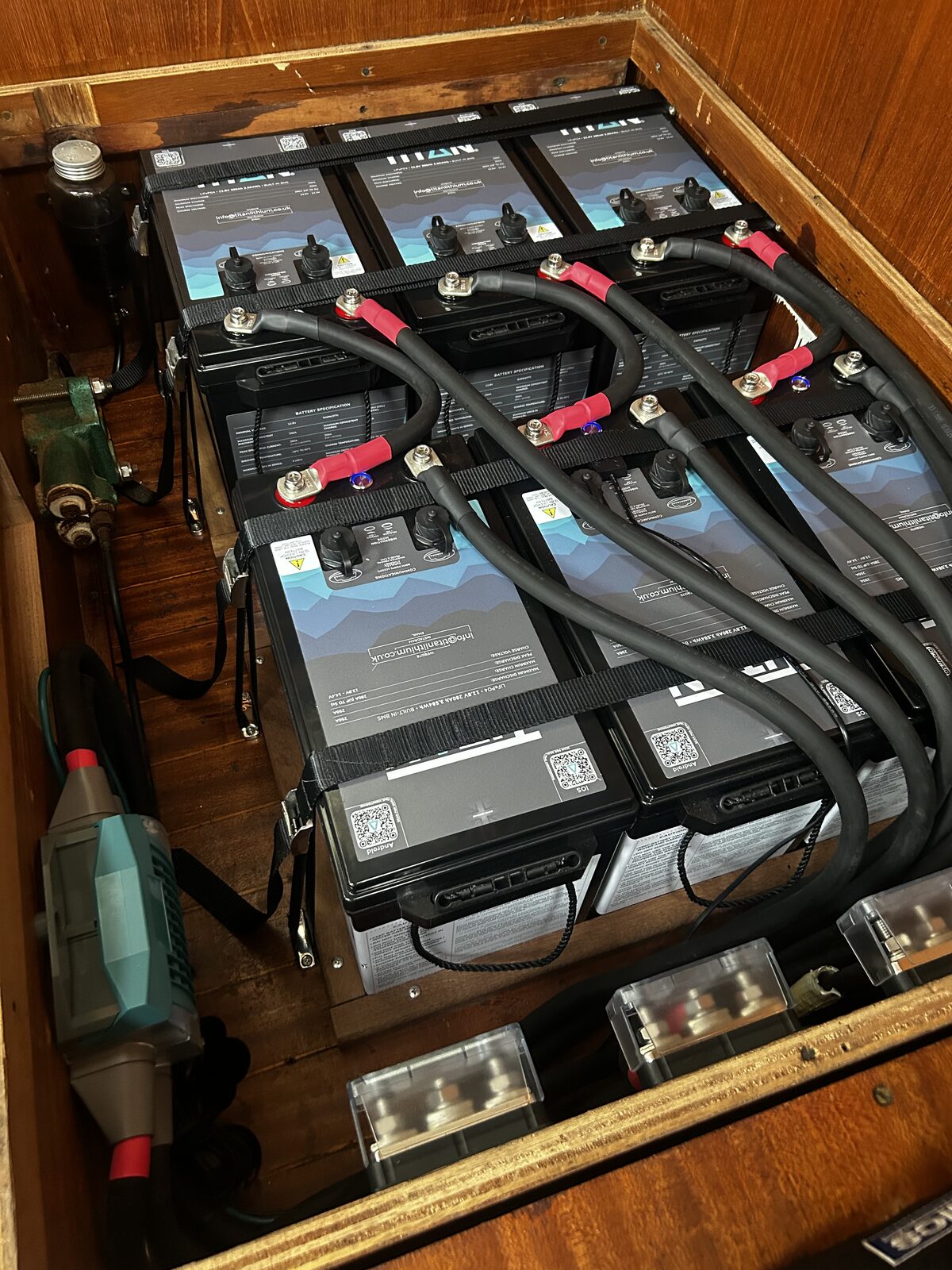
The six-battery bank, wired as three series pairs then paralleled, in its dedicated locker.
Rather than just wiring cells together and hoping they age evenly, the built-in BMS actively shifts charge between cells to keep them level. It's a small thing that matters a lot over years of deep cycling at sea.
LiFePO4 cells don't like being charged below freezing — TITAN's batteries have an internal heater that kicks in automatically to protect the cells, useful for an early-season Atlantic crossing or a cold night at anchor.
A phone app gives live voltage, state of charge, current draw and internal temperature without needing to open a locker or wire in a separate battery monitor.
Covered for manufacturing faults for the life of the battery — a meaningful backstop for a component the whole electrical system now depends on.
Charging Sources
A bank this size is only as good as what charges it and keeps track of it. Alongside the batteries, the refit fitted a full Mastervolt charging and monitoring system, matched to the lithium chemistry rather than adapted lead-acid gear:
The heart of the system — a combined inverter and battery charger. It turns stored 24V battery power into 230V AC for onboard equipment, and charges the bank at up to 100A from shore power or a generator.
Manages charging from the 800W solar array — two 400W panels wired in series — getting the most out of the panels through changing light and shading at anchor.
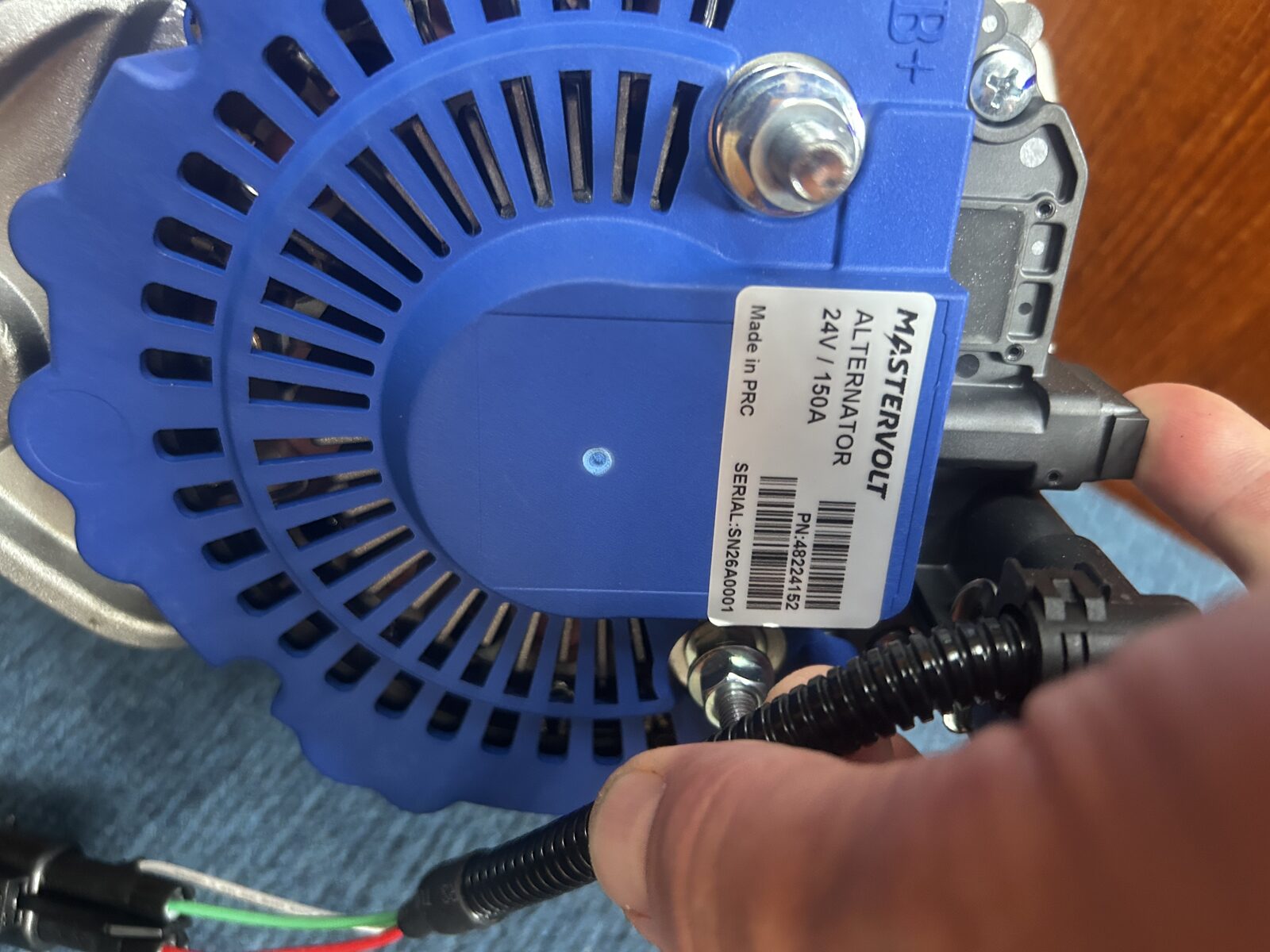
An upgraded, high-output Mastervolt 24V/150A alternator, giving the engine a genuine, controlled charging source instead of relying on a standard low-output alternator — and keeping the whole charging system, from alternator to battery monitor, on one manufacturer's ecosystem.
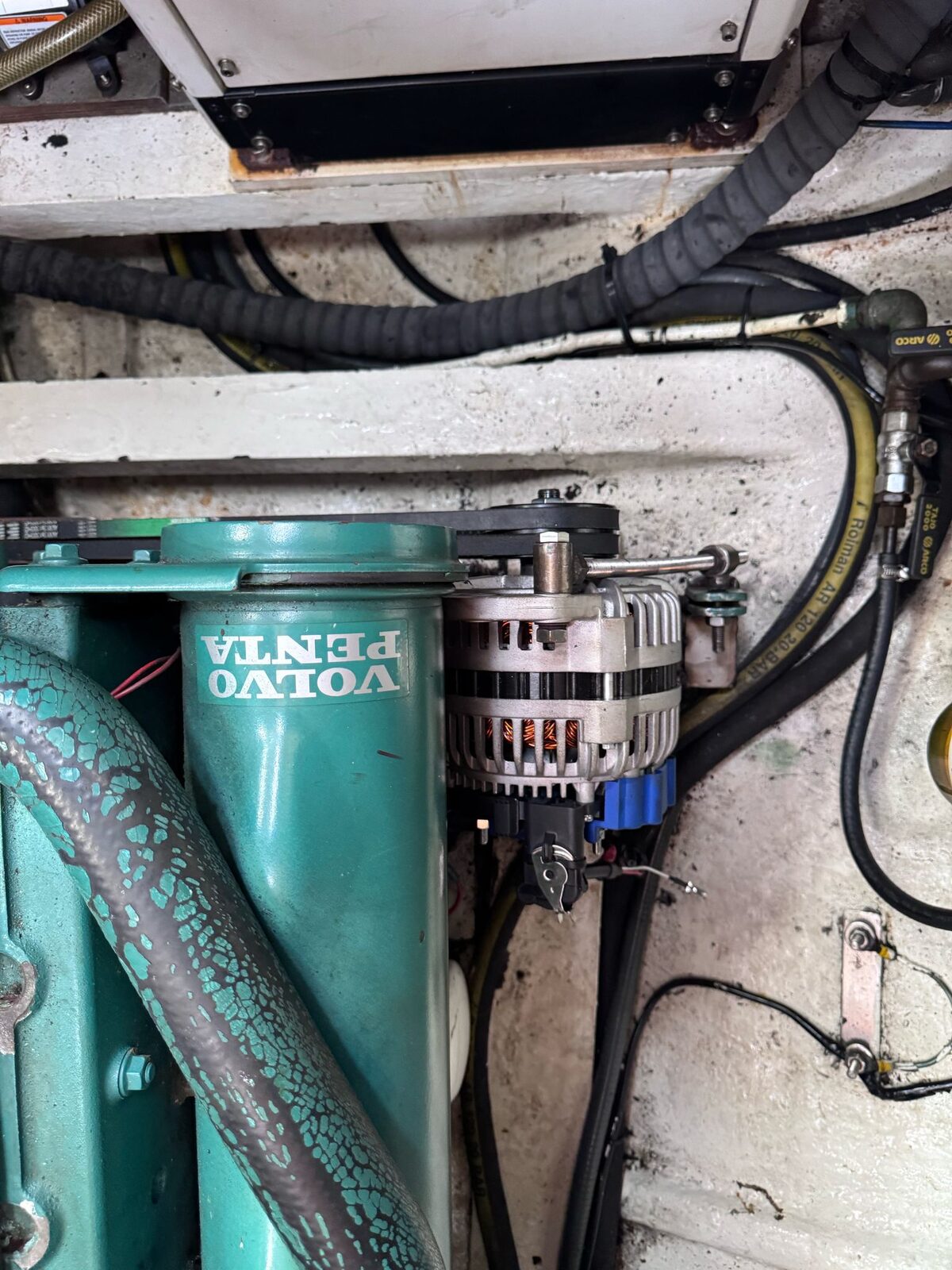
Mounted on the Volvo Penta, belt-driven straight off the engine — no separate genset needed just to keep the battery bank topped up underway.
Takes power from the engine/alternator circuit and steps it correctly into the lithium bank while underway, protecting the batteries from the wrong charge profile.
An additional dedicated charger, giving a further independent way to top the bank up.
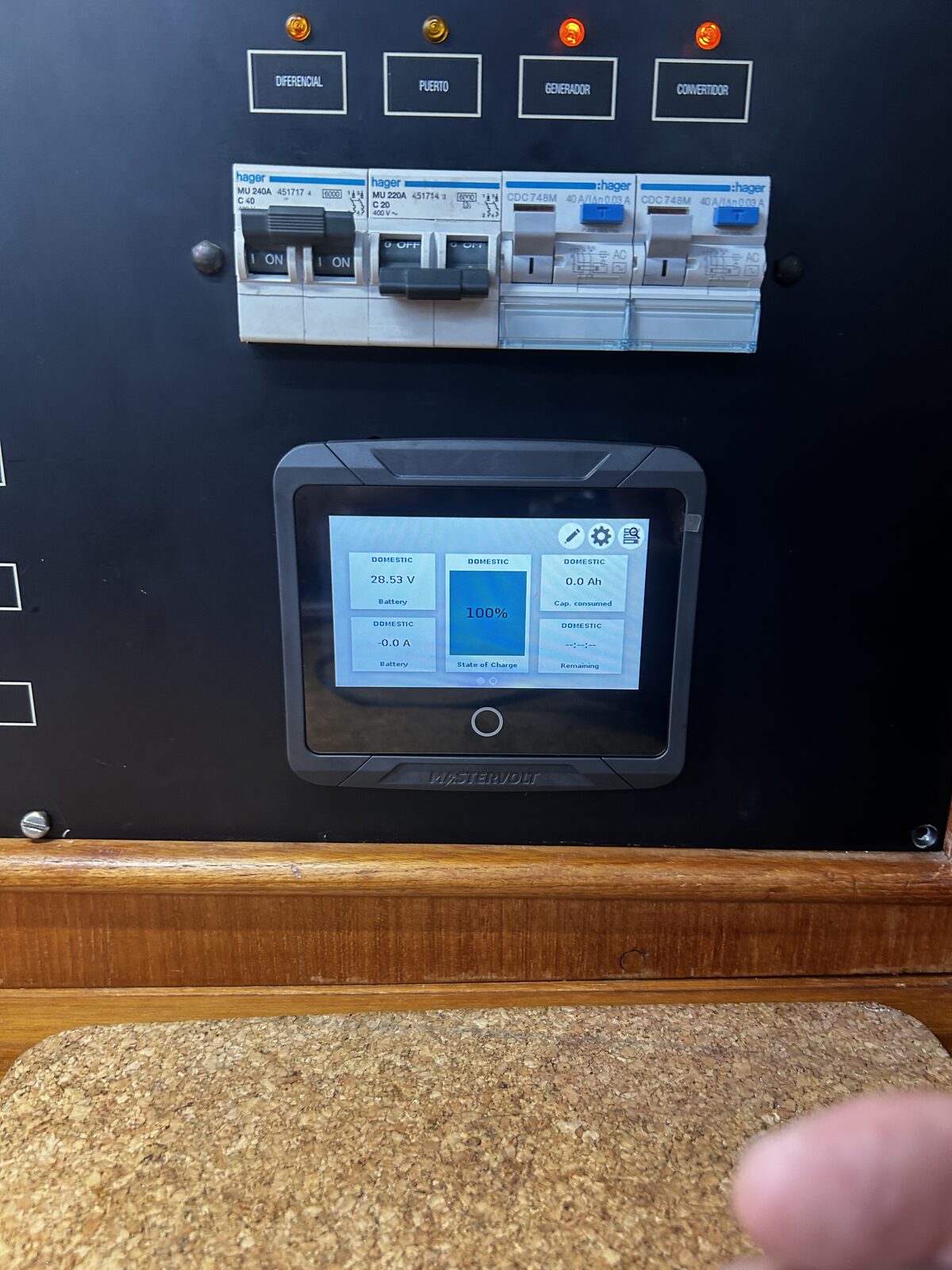
A precision shunt (with a 500A fuse) feeding a dedicated display, so exactly what's going in and out of the bank is visible at a glance from the nav station.
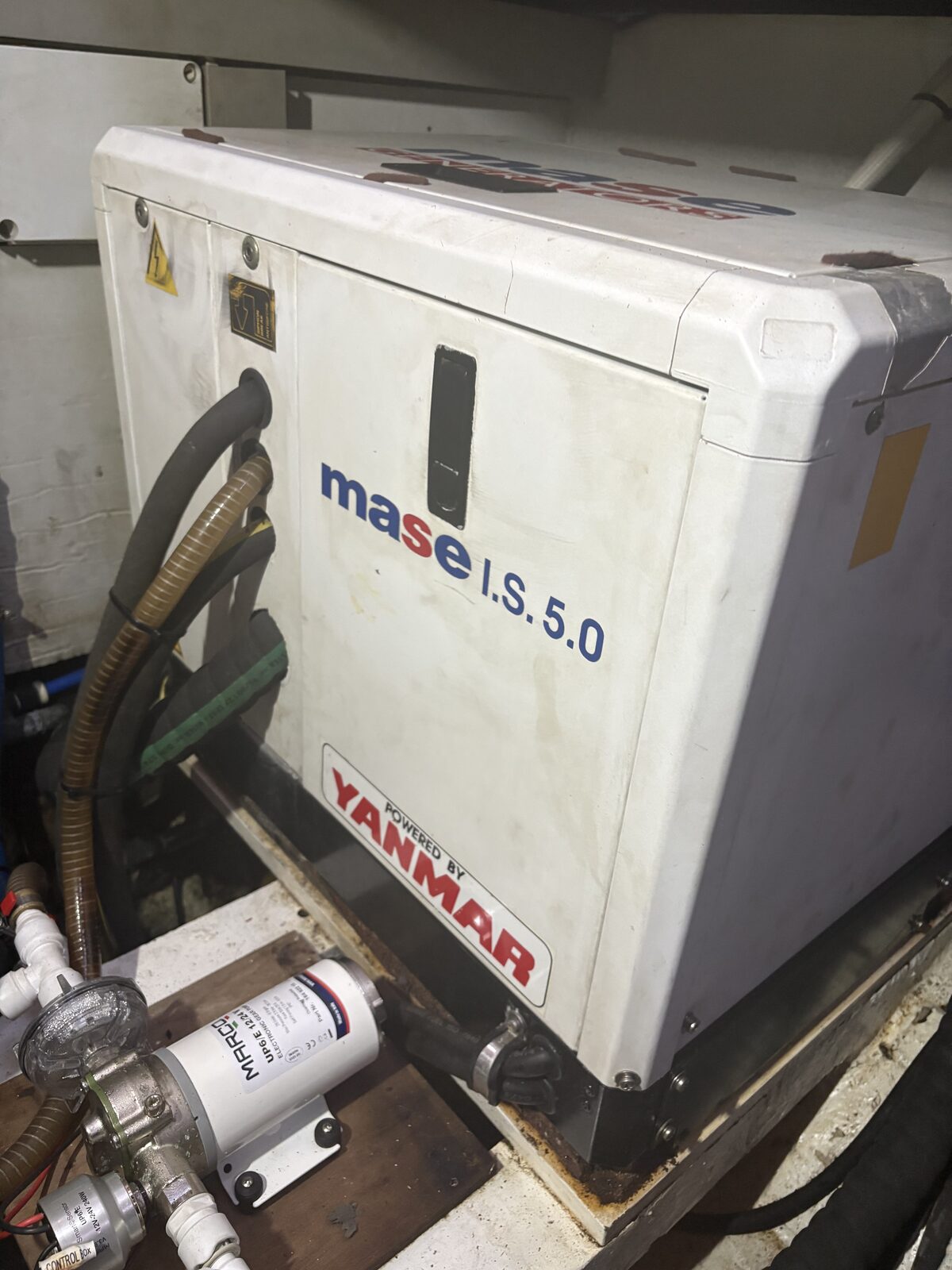
The backup source, feeding the Mass Combi Ultra when needed — in practice, rarely called on. A Mase I.S. 5.0, powered by a Yanmar diesel, tucked into its own soundproofed enclosure. In 2026 it's only been run for around 4 hours all year, just to keep it exercised and ready, with solar, the alternator and shore power covering everything else.
Between solar, the upgraded alternator, shore power via the Mass Combi, and the Mase generator as a backup, the 20.16kWh bank has four independent charging sources — which matters for genuine ocean passages, where any one source (cloud cover, engine hours, no marina) can't always be relied on alone. In practice, the first three do almost all the work; the generator is there for insurance more than routine use.
Voltage Architecture
The wiring is a little more layered than a single "24V boat" suggests. Each of the six TITAN batteries is a 12V unit, stepped up to 24V by wiring pairs of them in series — that 24V is the boat's main system voltage, running the bulk of the electronics, the Mastervolt charging gear, and the autopilot. But not everything aboard runs on 24V: equipment like the VHF radio and some other legacy electronics are 12V-only, so a 24V-to-12V DC-DC converter steps the system voltage back down again for that gear. In short: 12V batteries wired up to 24V for the main system, then stepped back down to 12V again wherever older or 12V-native equipment needs it.
Living With It
Honestly, the Mediterranean hasn't been a fair test of the system yet. Long, hot, sunny summer days here mean the 800W solar array does almost all the work on its own — the batteries sit comfortably topped up at anchor without the generator or even much help from the alternator. It's a good result, but it's the easy case, not the hard one.
The real test will come at higher latitudes and in greyer weather — shorter days, more cloud cover, and less reliable sun mean we do expect to lean on the generator more once Gran Blau is further from the Mediterranean. For now, that's a known trade-off rather than a problem to solve outright. Technology in this space is moving fast, and we'll keep looking at more efficient panels, better charge controllers, and other genuinely eco-friendly options as they mature, rather than assuming today's setup is the last word.
The general rule with LiFePO4 is to live mostly between 10–90% state of charge for the best long-term lifespan, and to run it up to a full 100% every so often to keep the battery's own charge-monitoring accurate — small habits, but ones worth mentioning to guests aboard who are used to lead-acid boats where the rules are different.
With six batteries wired together, the bank is also fully balanced once a year — charging all six to 100% together to bring every battery back to the same voltage, on top of the automatic active balancing each battery does internally. This matters more than it might sound: in a parallel bank, any voltage difference between individual batteries causes current to flow between them rather than to the loads that actually need it, which wears the cells unevenly and can shorten the life of the whole bank. Balancing the voltage across all six once a year is what keeps a bank this size performing evenly for the long run, not just each battery on its own.
Installation Notes
The upgrade was carried out by Enàutica, a marine electronics specialist based in Port Balis, run by Marc Mestre — quoted in January 2025 as a full "LiFePO4 Upgrade" package covering the six TITAN batteries and the entire Mastervolt charging and monitoring suite (Mass Combi Ultra, SCM60 solar controller, Mac Plus DC-DC charger, ChargeMaster Plus, MasterShunt 500 and EasyView5 display), plus around 30 hours of labour to fit it all.
Work like this is not a job for a weekend DIY approach — it goes on the boat that guests' safety depends on, so it's done by a professional or not at all. Marc trained as an electrical engineer in the Spanish Navy before spending many years partnering with Mastervolt, Raymarine and other top-tier marine manufacturers, and it shows in how the system was specified and installed. Finding trades you can actually trust has taken the better part of six or seven years of running this boat, and Marc is one of the few whose judgement is trusted without question — on a system this important, that trust matters as much as the equipment itself.
Worth noting: the equipment supply and fitting quote specifically excluded cables, terminals, busbars, fuse holders and fuses, circuit breakers, and the mechanical alternator installation itself — all priced and carried out as separate work. That's a fair reflection of what a lithium upgrade like this actually involves: swapping in new batteries is the easy part, and most of the real job is in re-doing the wiring, fusing and protection to suit lithium's higher sustained current capability safely, plus the physical work of fitting the new high-output alternator to the engine.
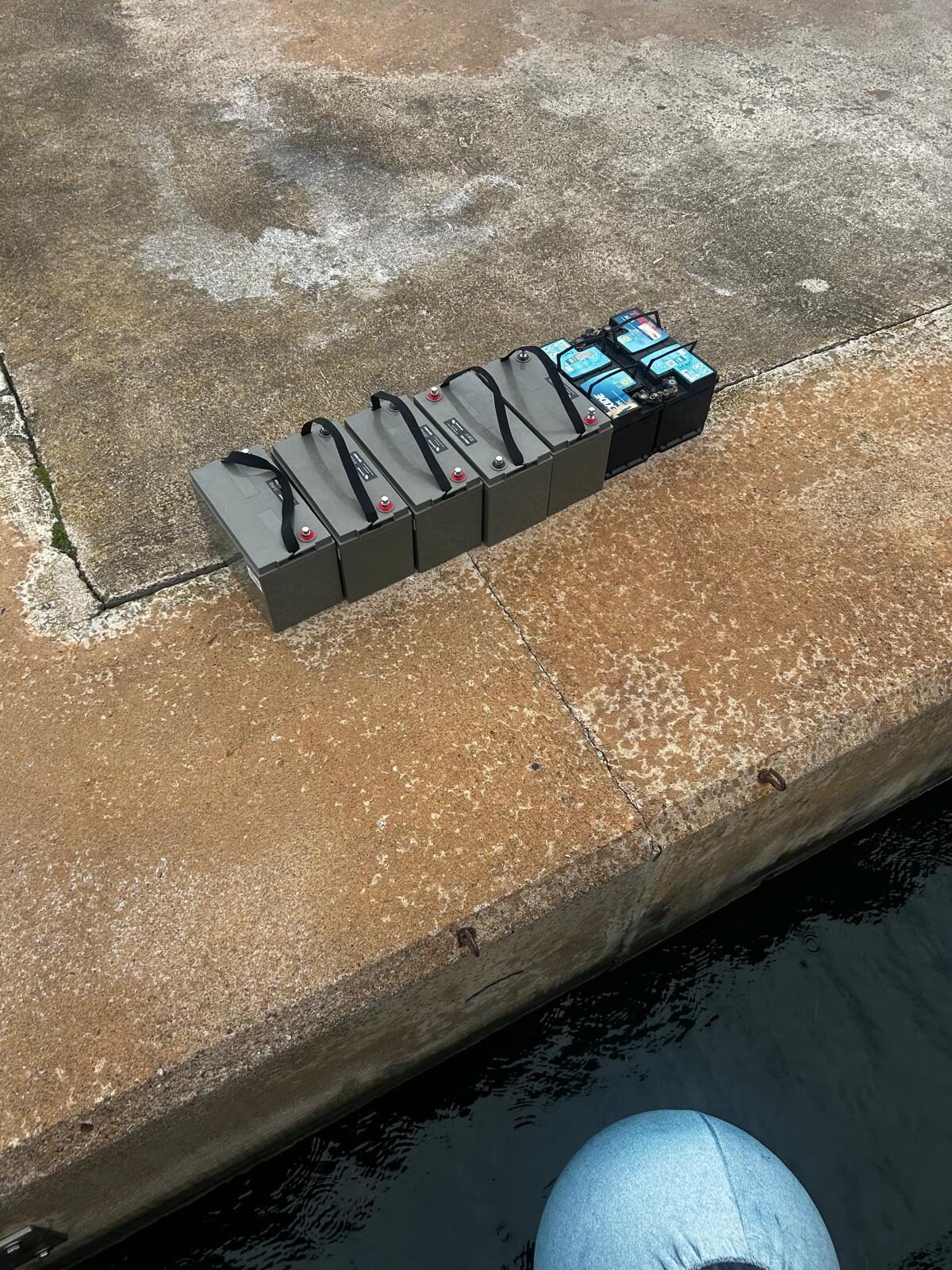
The old lead-acid bank, out and on the dockside, on its way to a new home.
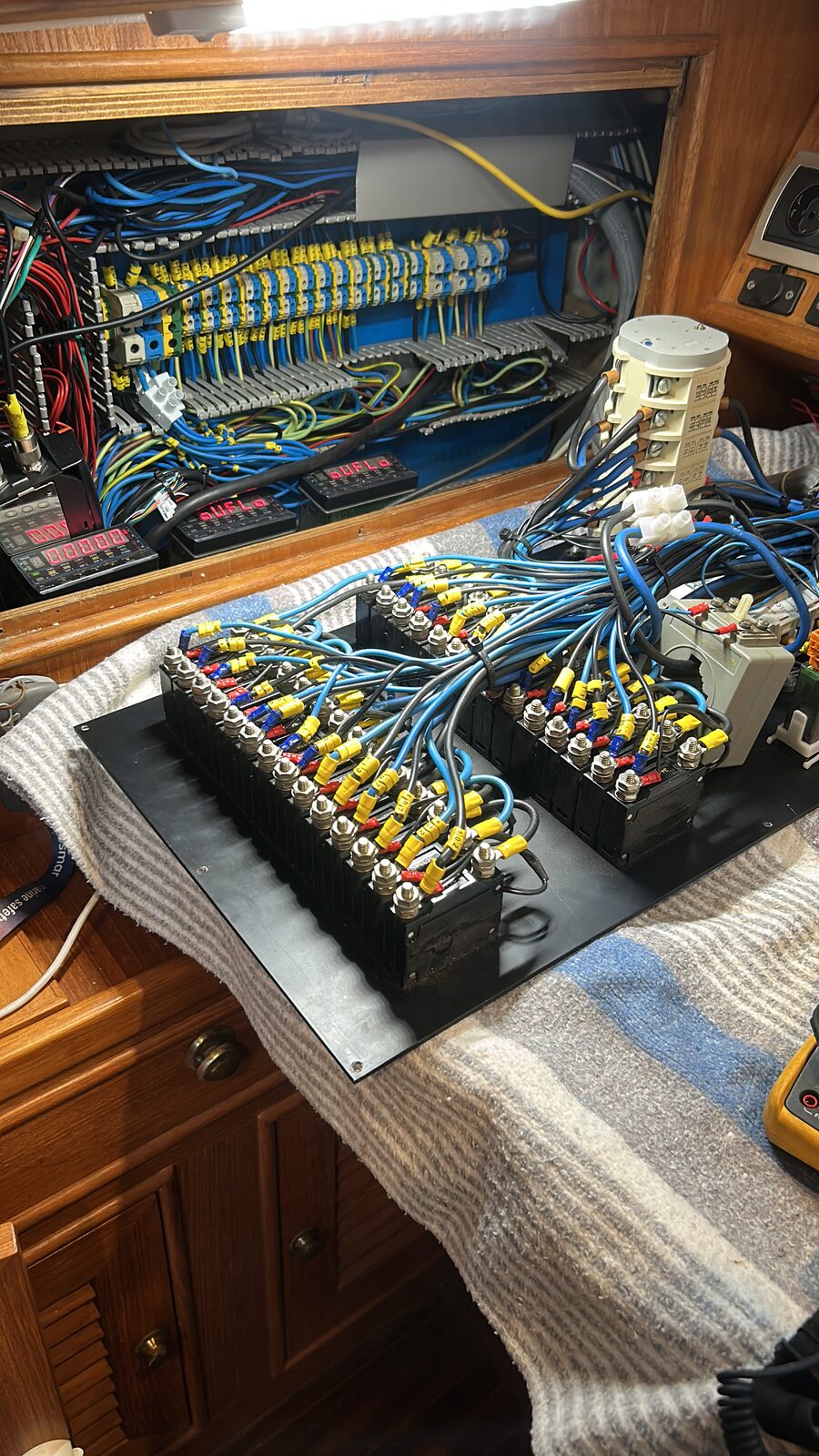
The AC panel being rewired by Marc as part of fitting the new inverter.
The whole upgrade was completed in January 2025.
More From the Refit
This is one of nine systems covered in the refit overview — see the rest, or sign up to the newsletter for each new review as it's published.
Read the Refit Overview Sign Up to the Newsletter