Journal · Gear Review
Four years, not one big-bang refit: new standing and running rigging in 2021, a couple of seasons learning what the boat actually needed, then new winches, mast tracks and furlers to match — twelve self-tailing winches and a fully battened sail suite giving the redundancy a cutter ketch rig is chosen for, backed by hardware that actually delivers it.
Gran Blau is rigged as a cutter ketch: four permanent sails in total — mainsail and mizzen, plus a staysail and yankee/genoa forward, the two-headsail arrangement that gives a cutter rig its name. More sails and more mast stations means more places sail handling can go wrong if the deck hardware isn't up to it, which is exactly why winches and mast gear were treated as a single job in the refit rather than an afterthought.
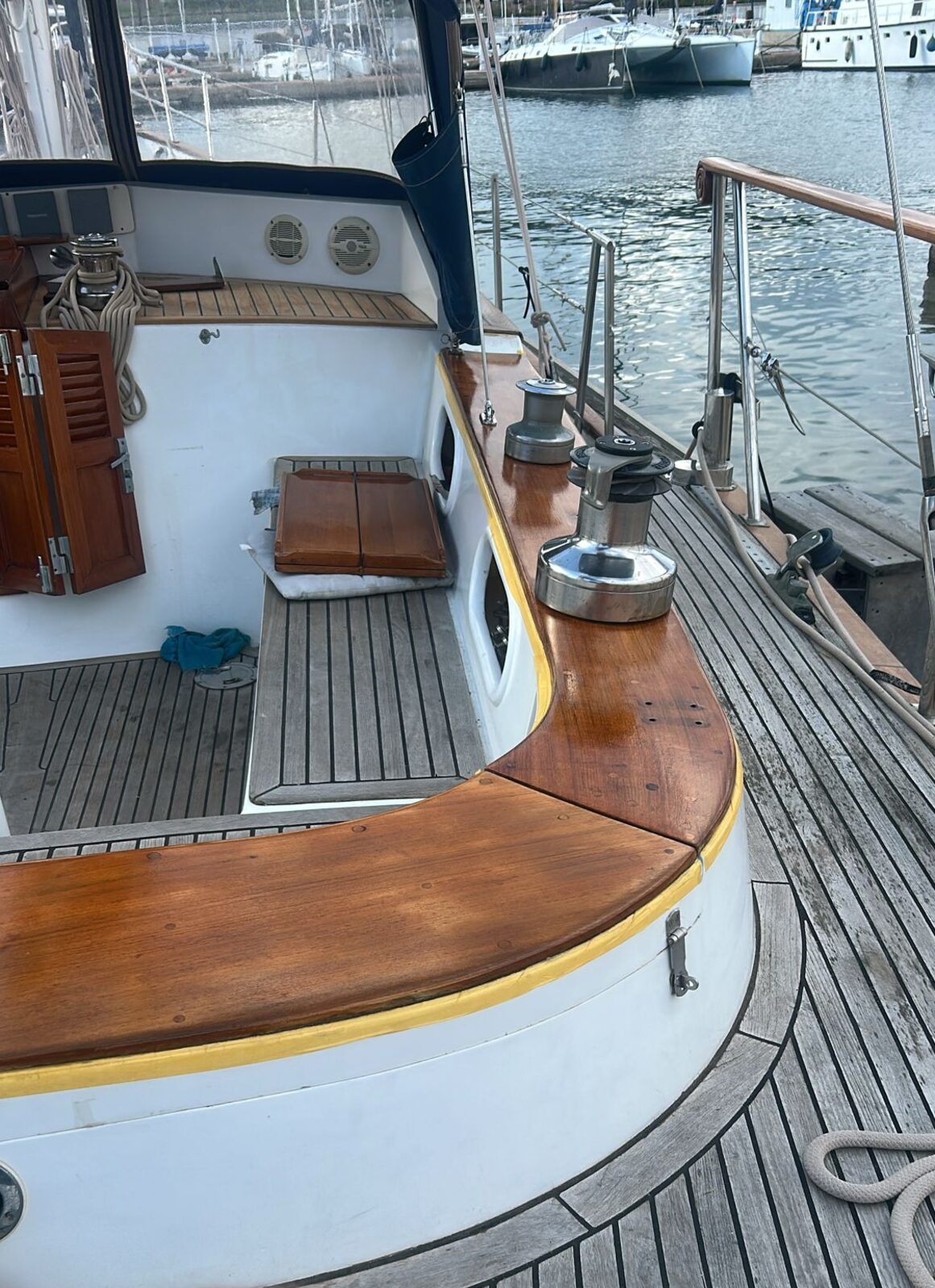
Before: two winches on each side of the cockpit, plus the small winch visible top-left by the companionway — that one belonged to the old traveller system, which ran across the coachroof rather than the cockpit.
It's worth seeing what this replaced. The old cockpit ran just two winches on each side — dated, undersized for the loads a cutter ketch this size puts through her sheets, and one short of what the boat actually needed. Grinding a headsail sheet home under load meant real, tiring effort, and in a breeze it could turn into a genuine struggle rather than a routine trim. The small winch visible in the top-left corner of the photo above, tucked by the companionway, belonged to the old mainsheet traveller system, which back then ran across the coachroof rather than through the cockpit — the awkward, out-of-the-way arrangement described below. Adding a third, properly sized winch to each side — six in total across the cockpit — is exactly what closed the gap.
This whole side of the refit has genuinely taken a few years, deliberately: new standing and running rigging first in 2021, then real sailing time to find out what the rig actually demanded before spending on winches and mast gear, rather than guessing upfront and getting it wrong. That patience is exactly why the winches, mast tracks and furlers fitted from winter 2025 onward are sized and specified against real experience, not a spec sheet assumption.
What's Fitted
One of the key requirements for genuine blue-water cruising is having enough winches, correctly sized, to give real redundancy — not just enough to sail the boat in good conditions, but enough that a single winch problem mid-ocean doesn't become a crew safety issue. Gran Blau now carries 12 Lewmar Ocean Self-Tailing winches across the boat:
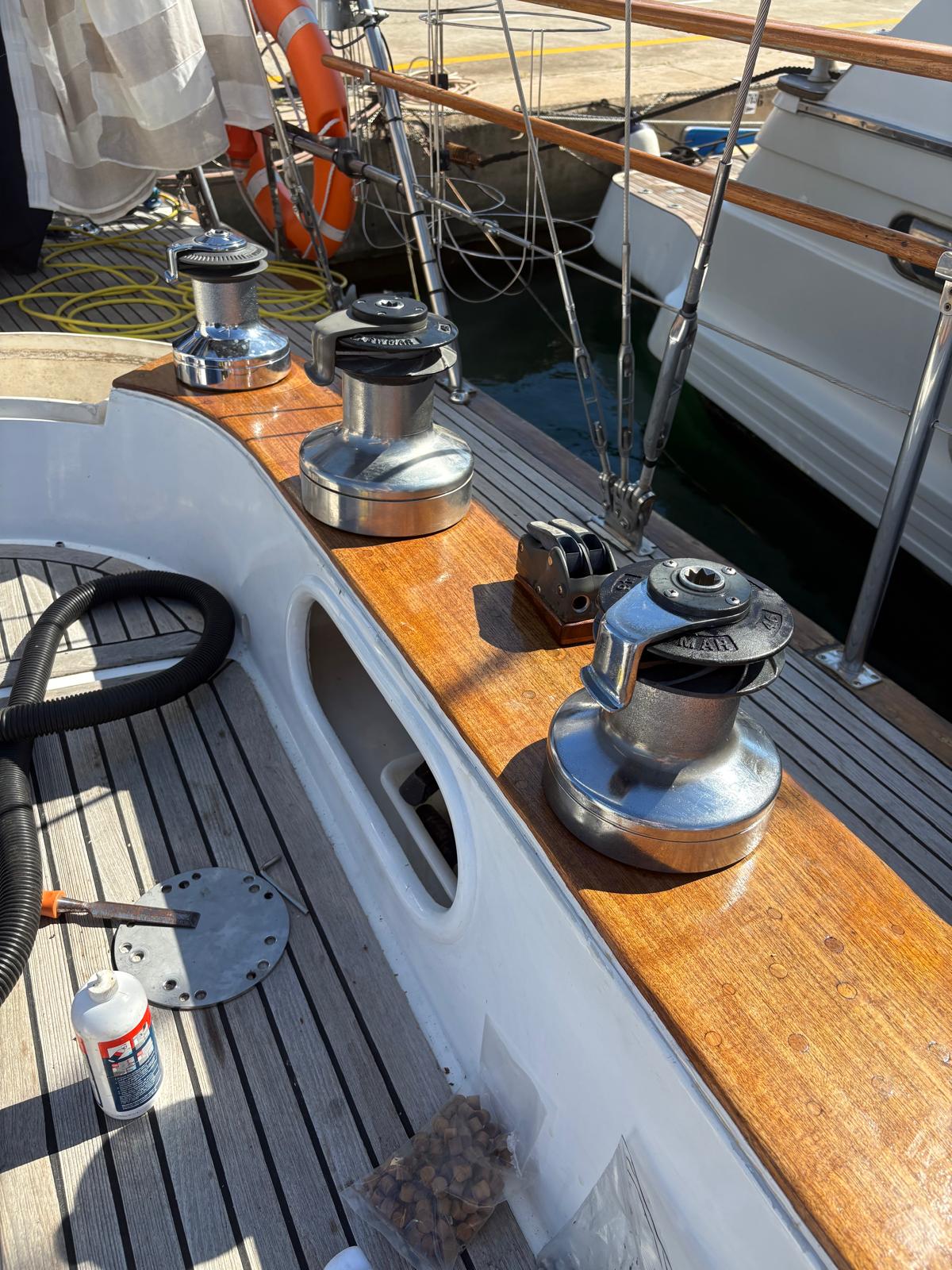
The main working winches for sheets and control lines led aft, giving enough stations that trimming and reefing don't queue up behind each other when the whole crew is busy at once.
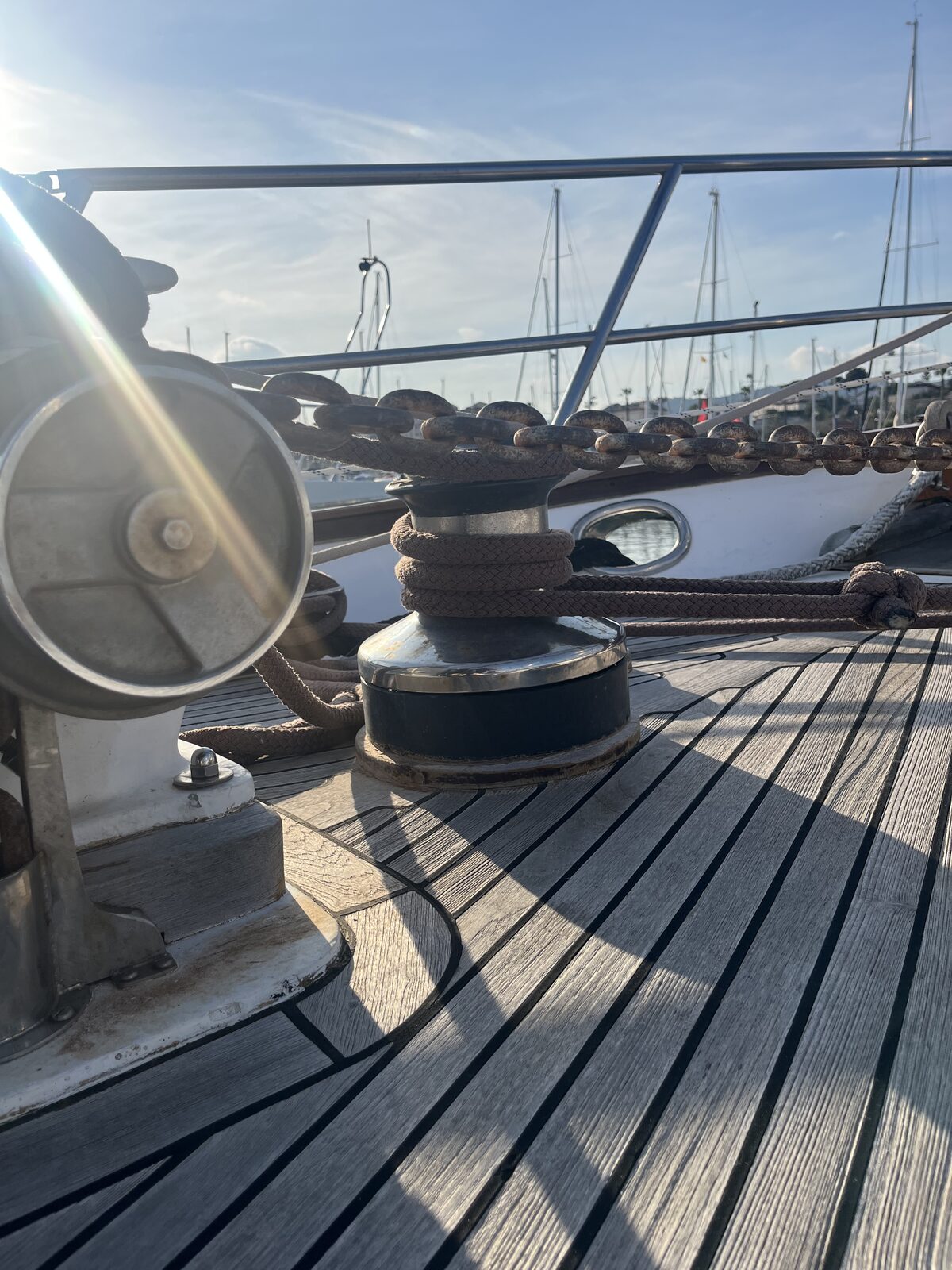
Dedicated foredeck winch for ground tackle and headsail work at the bow — exactly where extra mechanical advantage matters most when handling anchor rode or a headsail change by hand.
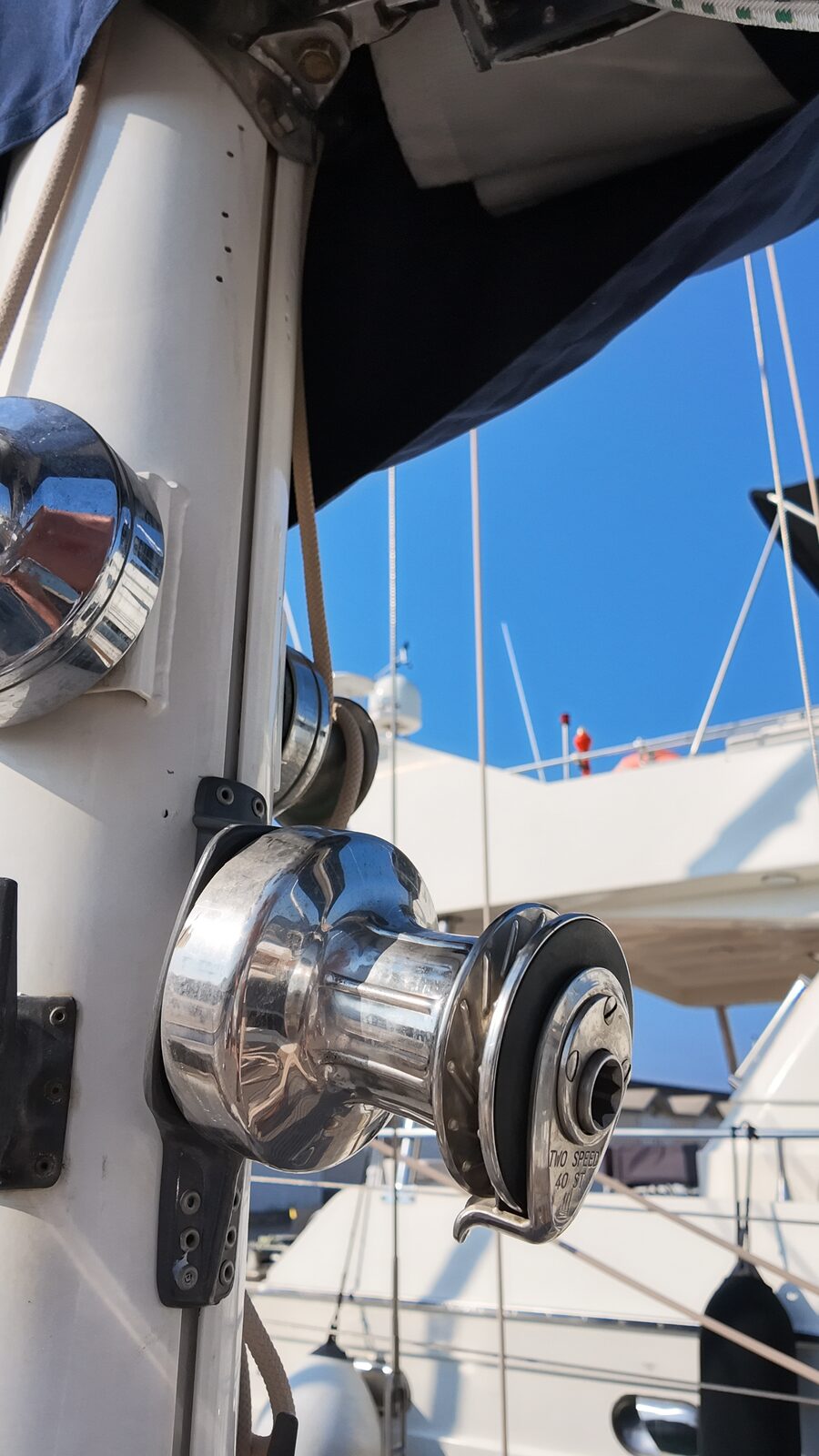
Halyard and reefing winches at the main mast, positioned so the mainsail can be reefed or dropped at the mast itself, not only from the cockpit — two-speed Lewmar 44 ST units, giving the extra low gear needed for hoisting under load.
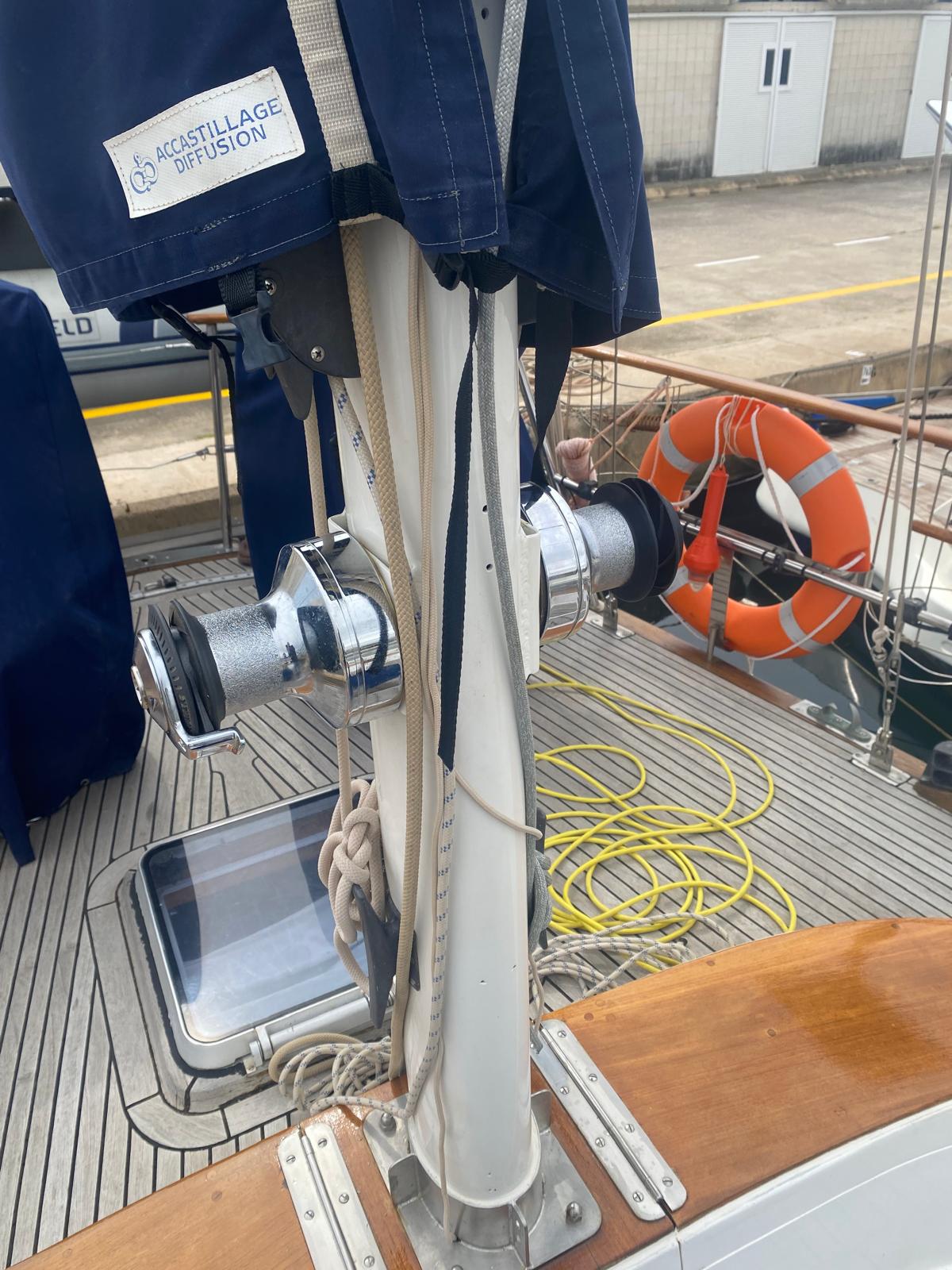
A dedicated pair at the mizzen, keeping the second mast fully independent for hoisting, reefing and dropping the mizzen without borrowing a cockpit winch.
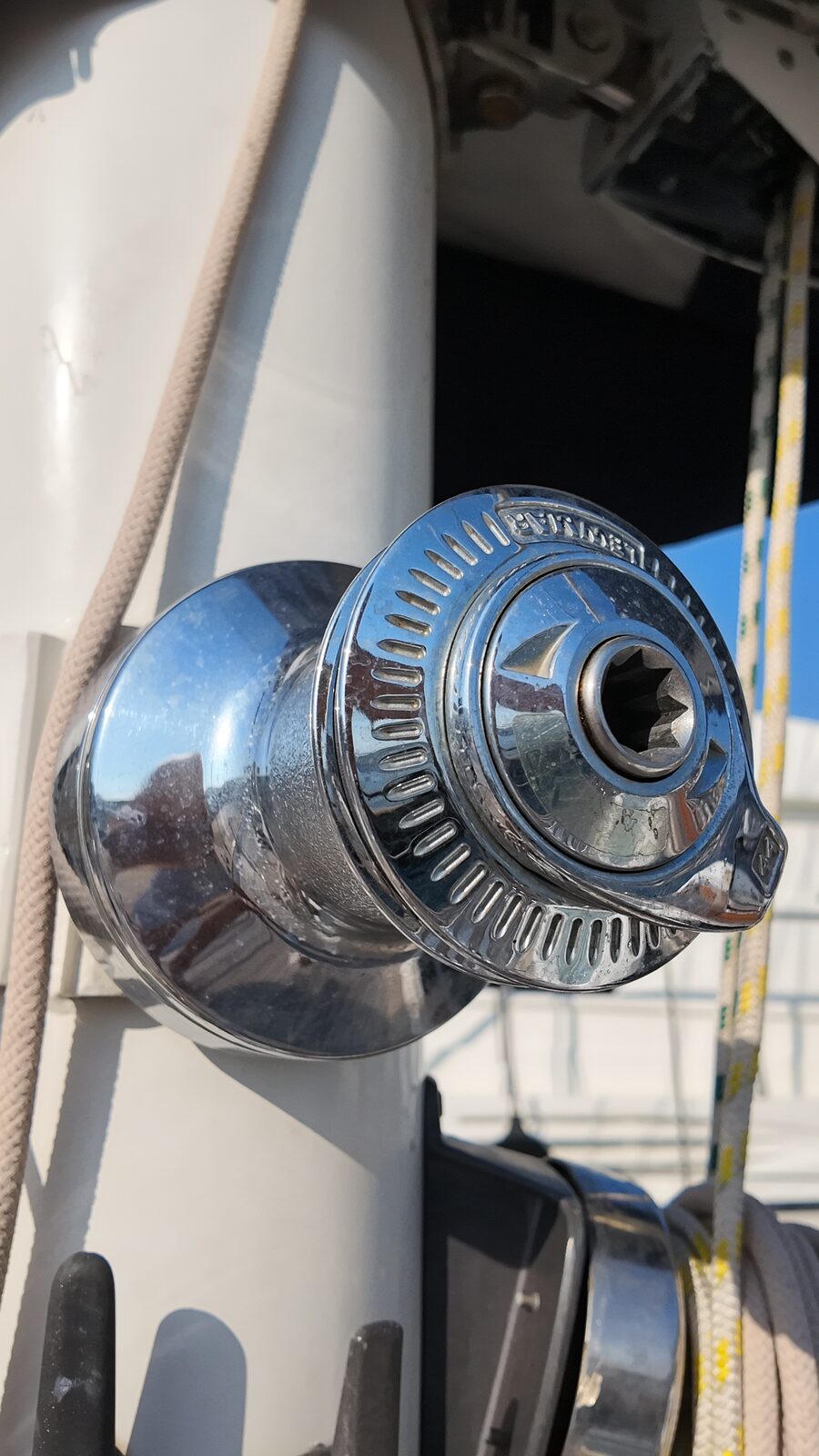
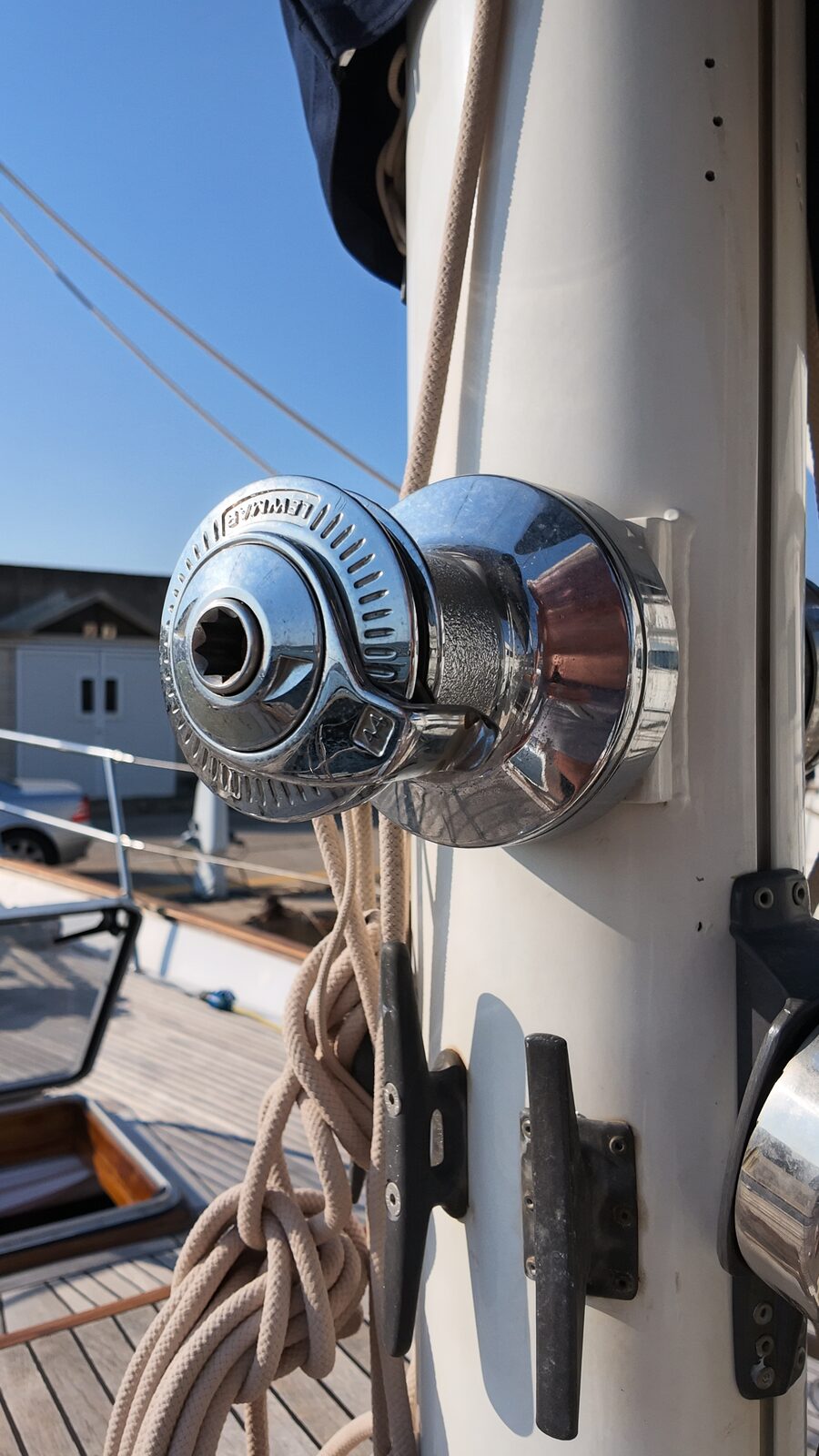
The Lewmar branding is stamped right on the drum top — no guessing what's fitted.
With winches at every mast station as well as the cockpit and bow, the same job can very often be done more than one way — the redundancy the ketch rig is chosen for in the first place, backed up by matching hardware rather than undone by it.
Mast Tracks & Reefing
New Seldén mast tracks were fitted to both the main mast and the mizzen, reducing friction on hoists and making it possible to raise, lower and reef either sail with noticeably less effort than the old setup — the kind of change that's easy to overlook on a spec sheet but is felt every single time a sail goes up or down.
Paired with the new track is a new reefing system on the main, with a dedicated self-tailing winch at the mast for it. In practice that means reefing off the wind — usually one of the more awkward points of sail to reef on, with the sail pinned against the rig rather than flogging free — is a genuinely straightforward, one-person job rather than a fight with sail and line at the same time.
Why a Ketch Rig
A ketch splits the sail plan across two masts instead of one, and that trade-off is exactly why it suits genuine blue-water cruising. Each individual sail is smaller and more manageable than the equivalent single mainsail on a sloop of the same size, which means less physical load handling any one sail and a lower centre of effort overall — both good news for a shorthanded or mixed-experience crew. The rig also gives far more ways to shorten sail as the weather builds: dropping the mizzen alone, sailing under mizzen and staysail with everything else down, or any number of other combinations, rather than the more binary choice a single-masted boat often faces between full sail and a deep reef.
The high-cut yankee forward adds to that versatility. Cut with a higher clew than a genoa, it keeps better visibility under the sail from the cockpit, sheds water more easily over the bow in a seaway rather than burying itself, and works well both on its own and paired with the staysail depending on conditions — giving a genuine spread of headsail options rather than a single all-or-nothing choice forward of the mast.
Deliberately, none of the twelve winches are electric. Electric winches add a failure point that mechanical ones don't have, and they can be genuinely dangerous — a powered winch doesn't stop just because a hand, foot or line has got somewhere it shouldn't, in a way a manual self-tailing winch simply can't replicate. With a rig split sensibly across two masts, smaller individual sails, and enough correctly sized winches for real redundancy, Gran Blau's rig doesn't need electric assistance to be handled safely and comfortably — the versatility of the ketch rig itself does that job instead.
The Sails
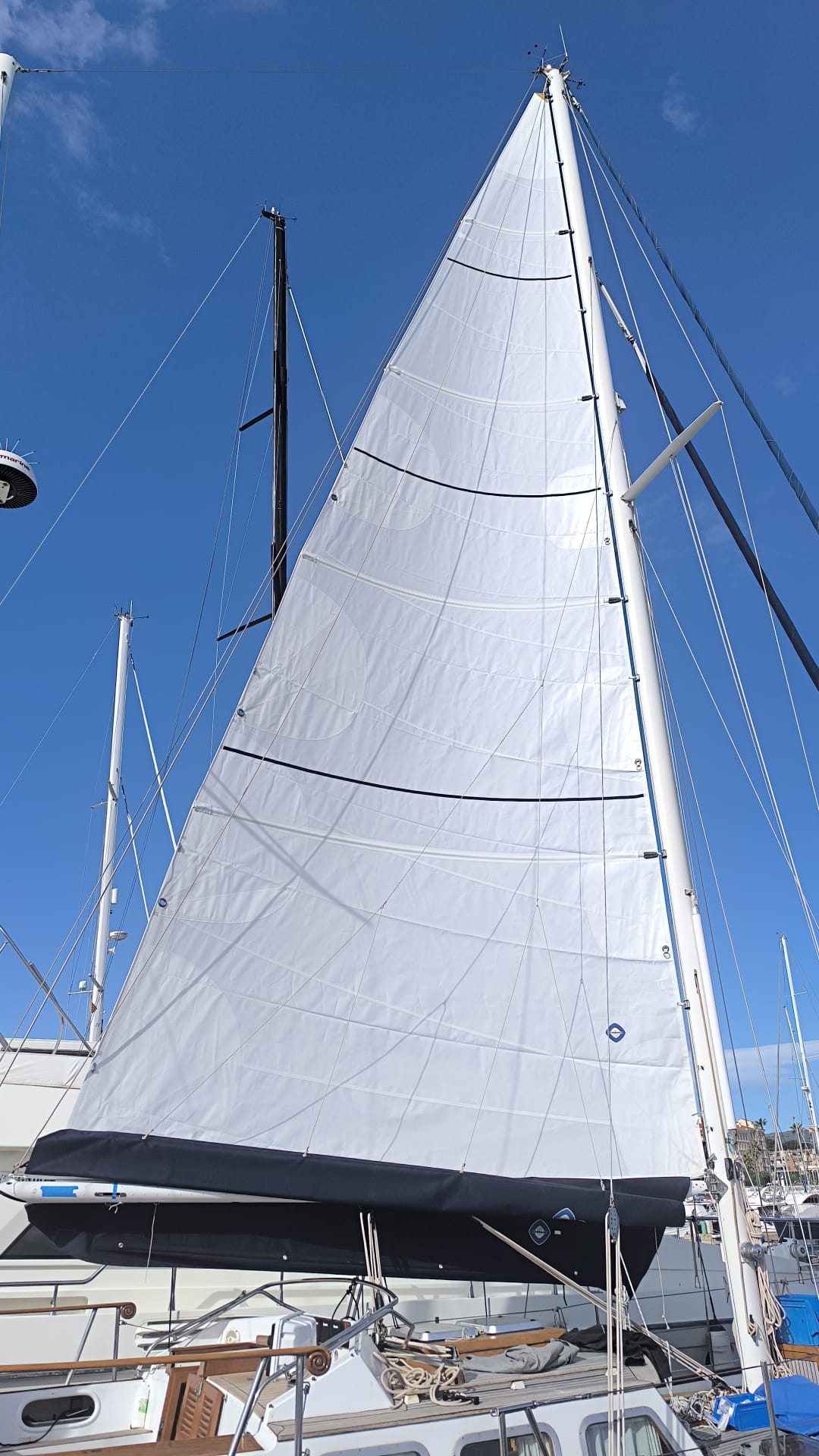
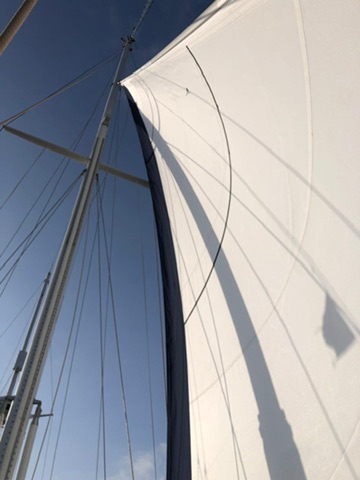
The new suite of sails (2024) fitted to match the rig is cut from Hydranet 8.8oz cloth, fully battened with 5 full-length battens and 3 reef lines — a durable, cruising-focused laminate rather than a racing sailcloth, chosen for years of hard offshore use rather than outright speed. Sails are precision cut by Quantum Sails Girona.
Furling System
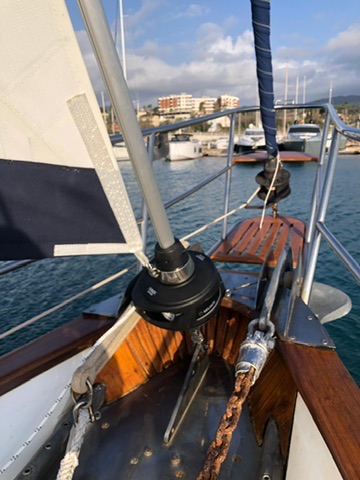
Both forward headsails were fitted with new Seldén FLX304S furlers in March 2025, replacing the original units — each sized to the sail it carries rather than a one-size-fits-all swap. The staysail runs a Ø8mm furler rated to a 15.45m luff, while the taller yankee runs the Ø10mm version rated to a 17.88m luff, so both headsails furl and reef smoothly under load without either furler being under- or over-specified for the sail above it. The staysail itself was replaced at the same time as its furler, rather than fitting new furling gear to the old sail.
Installation Notes
The mast, tracks, winches, furlers and standing rigging were all carried out by Nacho and his team at Mediterranean Rigging, based in Port Balis — the same team behind the new standing and running rigging fitted in 2021. Nacho is another of the small handful of tradespeople trusted implicitly with this boat, his work always guaranteed, in the same category as Marc at Enàutica on the electrical side: work like this only gets signed off to someone whose judgement is trusted without question, and Nacho has earned that over repeated jobs on Gran Blau's rig. Keeping the mast, tracks, winches and rigging with one trusted rigger rather than splitting the job between yards also means everything is specified to work together as a system, not fitted piecemeal by whoever happened to be available.
The mast, tracks and winches were done as a separate job over winter 2025, deliberately kept apart from the 2021 standing rigging work rather than bundled in at the same time. That gap mattered: a couple of seasons of sailing with the new rigging in place showed exactly where the old winches and mast gear were falling short, so the winter 2025 job could be specified against real experience rather than guesswork, once it was clear what actually needed upgrading. The furler work followed the same logic shortly after — quoted in February 2025 and invoiced in March 2025, with dismounting the original furlers, mounting the new ones, and replacing the staysail together accounting for around 20 hours of labour.
Living With It
Exactly how it was designed to. The old gear was undersized and genuinely difficult to handle, especially for some of the less experienced crew aboard — grinding a winch that's the wrong size for the load isn't just tiring, it's the kind of thing that puts people off sail handling altogether. These changes have transformed the boat: how she performs, and how she's actually handled day to day. Short-handed sailing, which used to take real effort and planning, is now genuinely a breeze.
One change worth calling out specifically: the mainsheet used to be handled from the coachroof, which meant reaching up and out of the cockpit to trim or ease it — not the safest place to be working a loaded line, particularly in a seaway. The mainsheet has since been brought back into the cockpit, onto properly sized winches alongside everything else. It's a small-sounding change, but it's exactly the kind of decision that puts safety and ease of handling at the top of the list rather than leaving a known weak point in place because it's always been that way.
More From the Refit
This is one of nine systems covered in the refit overview — see the rest, or sign up to the newsletter for each new review as it's published.
Read the Refit Overview Sign Up to the Newsletter